
Guillermo del Toro’s Frankenstein (2025): A Fairytale, Not a Faithful Adaptation
When it was announced that Guillermo Del Toro was set to direct a new iteration of the classic Frankenstein by Mary Shelley, to say I was excited would be an understatement. I’ve spoken before about how much I enjoy Guillermo Del Toro’s body of work and his devotion to shaping stories as dark fairytales. As soon as the film released in theatres, I was first in my seat, and for the next two hours I was transported into the pages of the book.
Make no mistake, however. This version of Frankenstein is truly Guillermo Del Toro’s vision. It does not seek to replicate Shelley, but Del Toro instead reinterprets her through his own directional lens. Essentially, he takes the parts of the story that apply to his own world and life and allows it to act as a living organism that molts, grows, and takes on an entirely new shape. It is in this organic space that I find the film to be the most captivating.
A Fairytale Approach to a Gothic Classic
Do I consider Guillermo Del Toro a horror director? Yes, but I believe his work also comes from an almost folkloric perspective. When I see his work, I am reminded of my own Hispanic upbringing where “horror” was embedded in every bedtime story. This is clear in his body of work whether through Pan’s Labyrinth or Crimson Peak. In fact, I would even argue that the latter film is an early draft of some of the visual and cinematic elements he includes in Frankenstein. Del Toro’s films focus on moral clarity, symbolic imagery, and emotional truth. His horror is the fear associated with myth.
In my opinion, Frankenstein builds upon and then further expands this philosophy. Instead of focusing on the scientific horror and moral ambiguity that defined Shelley’s text, the film reframes the narrative as a tragic fairytale about creation, longing, grief, and the monsters we inherit from our families. I have seen viewers critique the film as being too on the nose. For example, when William, Dr. Frankenstein’s brother, loudly declares to Victor, “You are the monster,” many fans groaned. To me this was forgivable because again, Del Toro’s work is a fairytale, a dark fantasy even, and for every direct line like this, there were leaps and bounds of further insight that made the film more meditative than I think some of the critiques give it credit for. Making Victor a memorable villain simply makes sense because it reaffirms the idea that madness combined with hubris wholly corrupts.
The Emotional Core of Del Toro’s Frankenstein
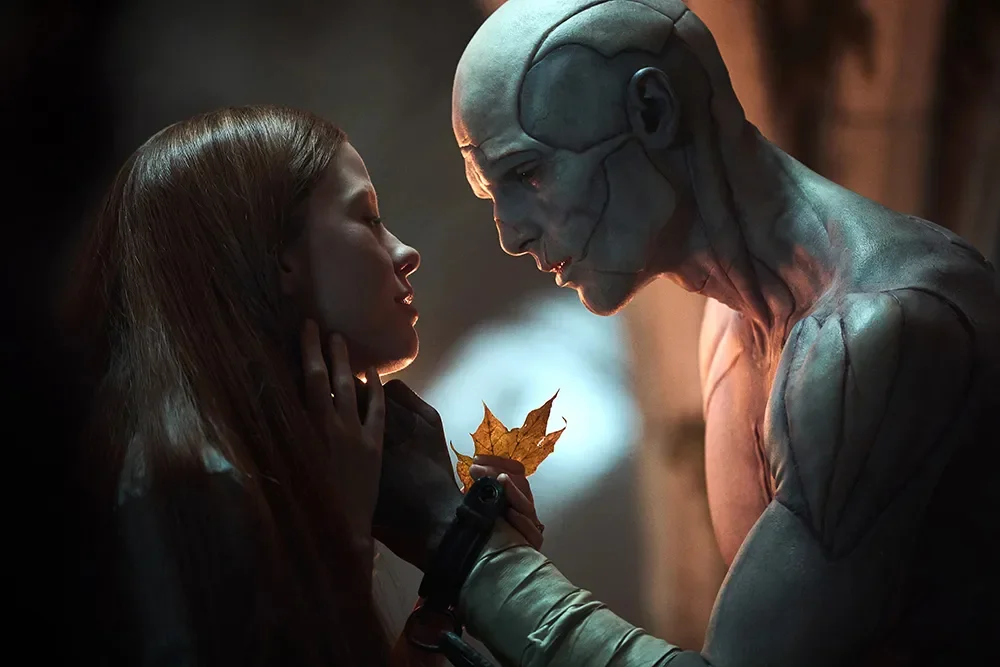
I will go over some of the key changes from the book to the movie in the next section, but if you haven’t read it, one of the greatest differences is how the monster is portrayed. In the book, there is moral ambiguity because the monster commits several crimes, including various murders. Del Toro does not treat the creature as a horrible monster, but as a wounded child.
In fact, Guillermo Del Toro has outright said he cast Jacob Elordi because of his deep, soulful eyes. In doing so, the film emphasizes the creature’s rising emotional intelligence, which greatly counters Victor’s guilt and avoidance. Further, the film beautifully touches on the idea of loneliness and human connection. The theme of being otherized often crops up in Del Toro’s work, and here the visual language reflects this along with reverberations of familial trauma.
The camera takes long, lingering shots. Lighting is stark and at times pinpointed to highlight or obscure certain elements. The emotional core of the film rests on tragedy, loss, and empathy, highlighting each individually and then all at once to allow the audience to see themselves through the eyes of the creature.
The Key Differences Between Frankenstein (2025) and Mary Shelley’s Novel
While Frankenstein is fairly close to the book in some ways, especially as there are still people who did not know the creature speaks, it is still not a literal interpretation of Mary Shelley’s original text. Below are the major differences that define the film’s unique identity.
Moral ambiguity is replaced with moral clarity. In the book, there are complex shades of grey. Both the creature and Victor commit harm and suffer in equal measure, creating a moral landscape filled with guilt, responsibility, cruelty, and consequence. In the film, it is clear that Victor is the true villain and the creature is a tragic figure shaped by Victor’s failures.
Shift in tone and structure. Shelley’s work is framed through letters, introspection, and the Arctic isolation that helps to frame said introspection. Del Toro creates dramatic immediacy, going from Victor’s childhood to his quick foray into bringing the dead back to life. I think it’s only maybe one or two shots from boyhood to his already work as a scientist.
Roles are changed or eliminated. In the book, Elizabeth is a cousin and Victor’s eventual fiancée. In the film, she is the niece of Henrich Harlander (a new addition to the story) and fiancée to William. Moreover, Victor has two brothers in the book, William and Ernest. There are other characters and deaths that are changed. I would like to consider it Del Toro’s remixing; it’s close enough to the source material but still very much his own.
Victor starts on a “companion:” In the film, Victor outright refuses, but in the book he does start work and then decides against it. This is where he cites that he does not want to create a race of monsters.
I would argue that many of these changes make sense, especially because the medium is film, which requires the director to make decisions that lead to concise narrative flow. Again, I think this is truly Del Toro’s version of the story and he took out, or changed, whatever would shift away from his tone and meaning.
The Subtext of the Frankenstein film
While some viewers found the film to be so overt it practically screamed meaning and metaphor, I actually think Del Toro’s film has a lot more subtext than one might assume. Yes, because this is framed as a fairytale, there are broad strokes, but that paintbrush still has psychological nuance.
For example, on my first viewing I had no idea that Mia Goth not only played Elizabeth, but also Victor’s mother. It is subtle but helps underpin the fact that Victor’s desire and guilt are both guided by his unresolved childhood wounds. This is why he also wears the red gloves and has those blood-red satin sheets. They are living reminders of the weight of his loss. The casting choice also really emphasizes an Oedipal undercurrent in a similar way that the constant drinking of milk by Victor does.
All these visual clues become subtle reminders of how fractured Victor’s psyche is. He is driven mad with hubris, yes, but there are layers of pain, shame, and emotional neglect that Victor does not confront. There is also subtext in the visual switching of roles. The creature becomes more refined, more human, as he exists in the world, whereas Victor becomes more monstrous. These choices elevate the fairytale into the realm of mythos. So as much as it is black and white, there are still psychological concepts that are worth exploring.
Del Toro’s Frankenstein Creates Its Own Myth

No matter how much Del Toro’s work departs from the original source material, I still find it to be a worthy adaptation. It is still filled with the same philosophical and thematic complexity that made this story relevant after centuries.
One should not go into this film expecting the same story. Del Toro is clearly more interested in emotional resonance than scientific inquiry, and he opts for tragedy over terror and confession over ambiguity. While this may disappoint audiences expecting a faithful philosophical adaptation, it aligns with Del Toro’s longstanding approach to storytelling. Fans of his work understand that in Del Toro’s world, monsters are never just monsters but reflections of human vulnerability. His protagonists are always haunted by emotions they cannot escape.
In this sense, the film’s divergence from Shelley is not a flaw but a creative choice that reveals what Del Toro finds meaningful in the story. And in that vein, Guillermo Del Toro creates his own myth around Frankenstein, one that, like Shelley’s work, that will likely continue to be explored generations from now.
DIVE DEEPER INTO CINEMA WITH MORE FILM ARTICLES







Explore how Buddy (2026) turns children’s TV into a nightmare about forced happiness, abusive control, repressed trauma, and unreliable authority.