
Hokum (2026) and the Horror of Misplaced Anger
I had a late start to the theatre this year, so this is officially the first horror movie I’ve seen in 2026. Though I saw the film when it premiered, I delayed this blog post because I wasn’t initially sure how I felt. While there were some rather interesting directorial decisions that I’ll dissect later, overall Hokum is a solid horror movie and is director Damian McCarthy’s most emotionally direct film while still retaining his signature ambiguity and dream logic.
Hokum (2026) is a supernatural horror film in which author Ohm Bauman (played by Adam Scott) travels to a remote Irish hotel to finish his latest book and symbolically scatter his parents’ ashes. Once there, he learns that a witch is haunting the honeymoon suite, and the story ramps up from there. In a future blog post I may tackle my theories on why witches have been recently popular in horror films lately, but that’s for another day.
What I found most interesting about the piece is that, like McCarthy’s Caveat (2020) and Oddity (2024), the protagonists of the film are not only morally complex, but they are also people who are unable to place blame correctly. Hokum encapsulates this because underneath the supernatural horror mystery is a work about displaced guilt, emotional projection, and, more importantly, misplaced anger.
Damian McCarthy’s Horror Formula
While I have never seen the director’s short films, after this final installment, McCarthy’s directorial framework becomes clear; he enjoys creating works in which scenes feel like folklore fragments and dreams rather than traditional linear scripts. In many ways, that works. Especially when certain narrative devices stand out:
Character Entrapment
In Damian McCarthy’s films, the characters are emotionally trapped long before they become physically confined. Whether it’s the isolated house on an island in Caveat, the cursed domestic spaces in Oddity, or the haunted hotel in Hokum, these remote settings become a manifestation of unresolved guilt, the psychology grief, and paranoia. The horror comes from realizing escape was never truly possible because the characters are imprisoned by their own emotional wounds.
Narrative Reveals
McCarthy structures his stories like slowly unraveling nightmares, where each reveal forces the audience to reinterpret earlier scenes. Information is deliberately fragmented, as mentioned earlier, creating a constant tension between what is supernatural and what is psychological. The slow then fast buildup manifests devastating emotional revelations rather than traditional horror twists.
Haunted Architecture
Crumbling homes are a horror staple, but McCarthy also adds additional atmospheric elements that are born from innovation. In Hokum, for example, we not only see the decayed interiors and hidden passageways, all hallmarks of supernatural horror, but we also see creepy dumbwaiters, rusted bolts, and even a moldy and rotted jacuzzi with rancid green water. He elevates gothic horror in a way that each set visually gives off the sense of trauma.
Strange Symbolic Imagery
McCarthy repeatedly uses unsettling symbolic imagery that feels pulled from folklore, dreams, and half-remembered childhood fears. Rabbits are often shown, but so are dead animals, distorted human figures, and other objects that appear as emotional symbols rather than just overt plot devices. This layered symbolism gives his films a lingering ambiguity where viewers can walk away with entirely different interpretations of what they witnessed.
The above works well to make Hokum and the other two films stand out. In Hokum, especially, I find it intriguing how the symbolism can blur together. The dreamlike overlapping with folklore aspects of the film is what draws me, but what sometimes take me out is that some of the ideas can make things convoluted. For instance, Fiona, played by Florence Ordesh, was wearing a rabbit costume, which made sense because, in Irish folklore, rabbits are considered harbingers when spotted, and as a symbol, they are able to travel between the human world and the “Land of the Young” (Tír na nÓg) or the Otherworld overall.
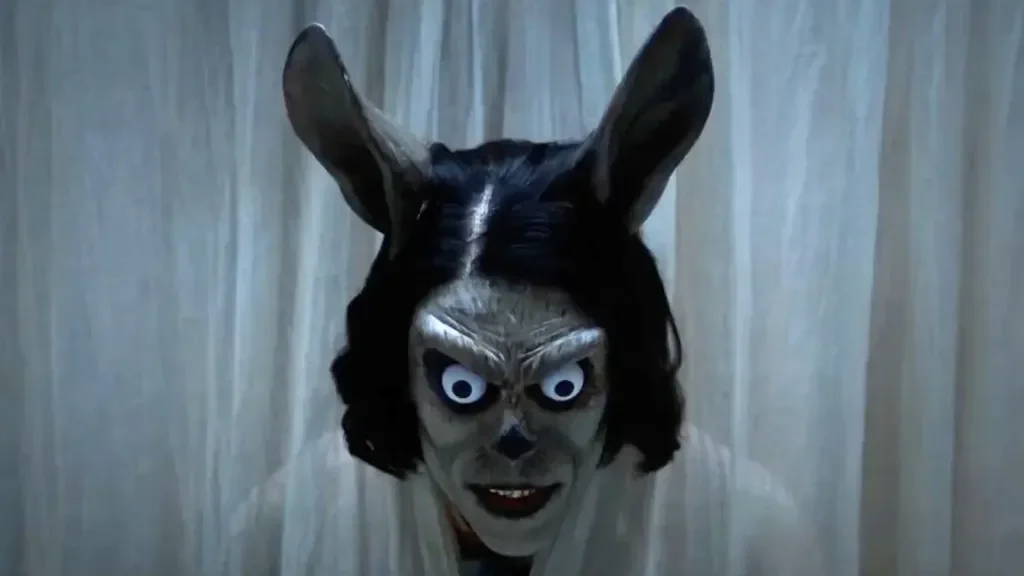
In relation, I thought the bulgy-eyed TV host was also a rabbit, but he is actually “Jack the Donkey.” It is meant to be a nod to Pinocchio’s (1940) take on transformation through moral failure. By McCarthy’s own admission, he always wanted to use the jackass imagery in a movie one day. It is those add-ins that I think creates more confusion than clean mythology, but despite this, the impact of the bleeding symbolism still provides enough momentum that this can be overlooked.
Misplaced Anger as the Core Horror of Hokum
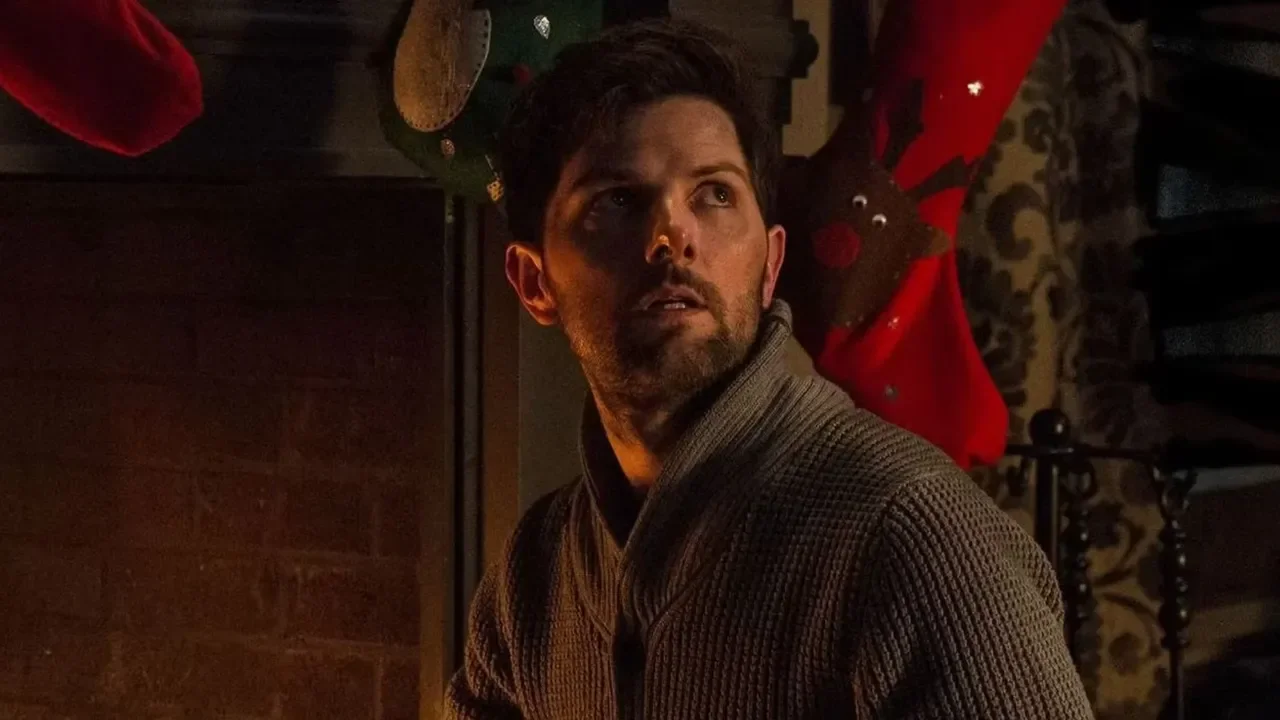
The thesis of the film is not about supernatural evil, but the emotional displacement and unresolved anger, often turned both inward and outward, through Ohm. Throughout the story, Ohm is cynical, rude, and in the case of a quick scene involving the bellhop, Alby, he is downright cruel. Through a reveal later in the film, the audience learns this is because of buried shame involving an accident tied to his mother’s death. Rather than confronting that pain directly, Ohm externalizes this unresolved trauma in the way cold way he treats others. It is important to note that this isn’t a full stop; he also internalizes it into a type of self-hatred that comes out through alcoholism and self-destruction.
As the narrative continues to unfold, the supernatural events become a manifestation of his mental state. While not entirely literal, in an atmospheric sense, it does well to show how Ohm is forced to confront his fragmented memory, including the singular moment that caused his mother’s death. We understand where his anger comes from, not from malice but from extreme self-loathing.
While Ohm’s character never won me over, and I never felt a true, deep remorse, which I also felt made him realistic, I can appreciate the character arc and tangible growth shown on screen. McCarthy’s protagonists often believe they are avoiding pain when, in reality, they are feeding it. It is in that a realization that real change begins.
Fiona and the Tragedy of Secondary Victims
If Ohm represents the idea of a person refuses to deal with painful truths, then Fiona represents the secondary characters that are so emotionally open that they are then pulled into the emotional black hole of those like Ohm. While Ohm is guarded, cynical, and emotionally fragmented, Fiona enters the story with warmth and vulnerability that immediately contrasts with his emotional distance. Her attempt to form a genuine human connection, and in some ways, this works, creates the first tearing down of the thick walls he has built around himself.
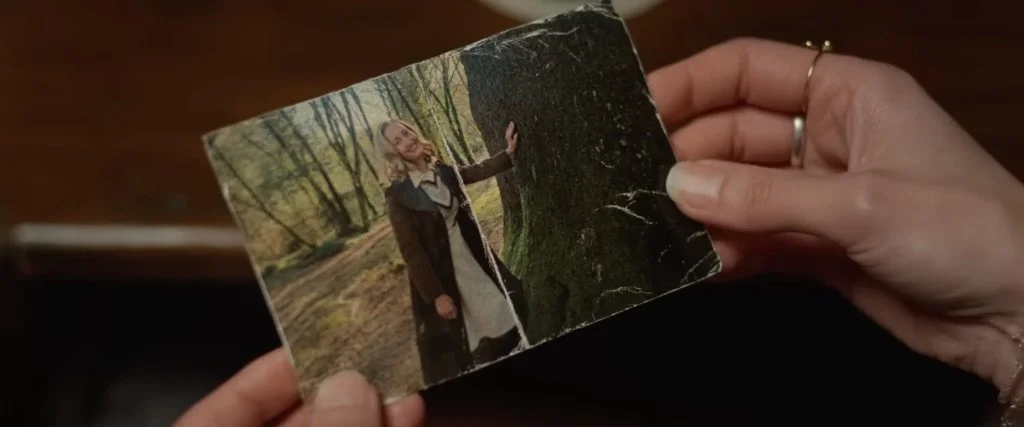
While I won’t go into spoilers, her character is truly a harbinger of the pain that follows acceptance of the source of guilt, and in equal amounts, how anger impacts others. I also find it interesting that thematically she also connects to both Ohm’s mother and the witch. It creates a cycle of women tied to guilt, blame, and emotional projection. His mother is the original wound, and the witch is almost like a physical embodiment of his inward rage, meant to punish.
Fiona is tragically caught between those two worlds, reinforcing one of McCarthy’s bleakest ideas: pain that is left unacknowledged rarely stays contained to a single person. Instead, it spreads outward, reshaping relationships, distorting love into guilt, and turning emotional wounds into something almost supernatural in their ability to consume everyone nearby.
Caveat, Oddity, and Hokum as a Trilogy of Guilt
As mentioned earlier, Damian McCarthy’s three feature films are incredibly close tonally, which creates the question of whether Caveat,Oddity, and Hokum are a sort of trilogy. While the director creates intentional connective tissue between the films, they are not a part of a trilogy, and instead, are part of the same universe. As noted by McCarthy in a Fangoria interview about Hokum, the couple in the hotel are the same from Caveat who end up killing each other, and the desk bell is from Oddity.
These are clearly fun easter eggs, but what makes each film stand out is that, should you watch them in succession, it becomes clear that McCarthy is building an escalating study of emotional deterioration and unresolved guilt within his body of work. Caveat explores fear and repression through uncertainty and manipulation, Oddity shifts toward grief and vengeance, and Hokum feels like the culmination of those themes, examining how self-blame and misplaced anger can consume a person entirely.
The atmosphere and immersion of folklore is commendable, but Hokum shows that McCarthy’s true talent is in the realization that some people become haunted the moment they stop confronting the truth about themselves.
DIVE DEEPER INTO CINEMA WITH MORE FILM ARTICLES








Explore how Buddy (2026) turns children’s TV into a nightmare about forced happiness, abusive control, repressed trauma, and unreliable authority.