
Buddy (2026) Turns a Barney-Like Children’s Show Into Pure Horror
Step Inside the Colorful Nightmare of Buddy
- How Buddy transforms a cheerful children’s show into a surreal nightmare
- The creative connection between Buddy and Casper Kelly’s Too Many Cooks
- What Buddy represents as a loving but unreliable authority figure
- How forced happiness, memory loss, and episode resets reflect cycles of control and trauma
- Why the film uses mascot horror to explore the danger of letting others define your reality
If you weren't aware, many popular theaters play mystery movies in which the audience does not know what will be shown until the film starts. It's a great way to create buzz and get the audience engaged before release. There are special horror editions, and that is where I was treated to Buddy (2026), directed by Casper Kelly. As of today, most theaters are now showing this odd, engaging, and memorable film.
Buddy has a simple premise as far as horror films go. It is a surreal horror comedy set inside a cheerful 1990’s children's television program that looks eerily similar to the Barney series. However, unlike the beloved purple dinosaur, the character of Buddy, played by Keegan-Michael Key, is an orange unicorn that is completely harmless…that is, until one of the children does not follow his instructions.
What follows is a foray into mascot horror, surrealism, and a deep dive into the horror and childhood that can come with forced obedience and misuse of authority. Plus, some moments are really, really funny.
What is the film Buddy About?
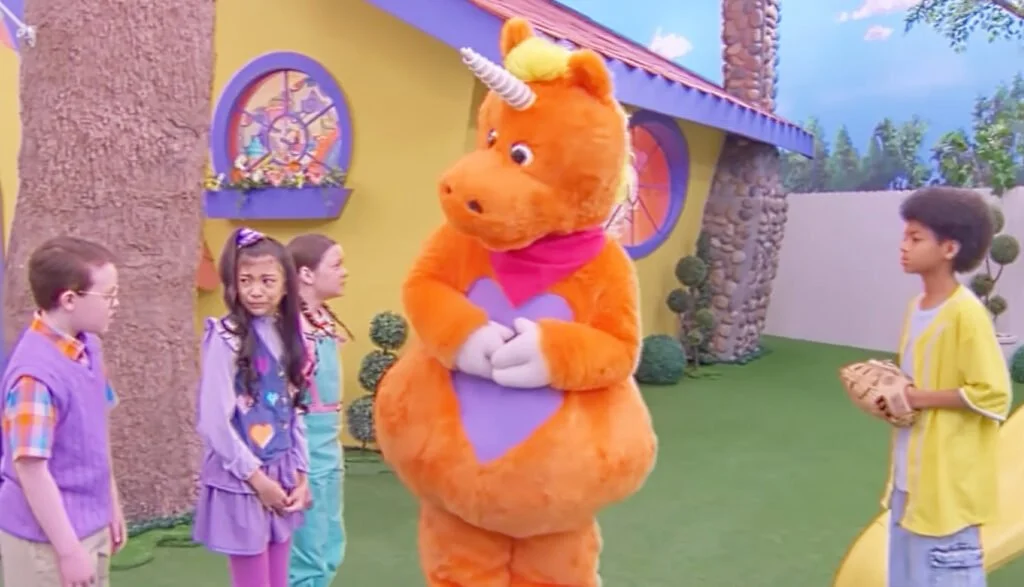
The 2026 horror film Buddy quickly introduces It's Buddy!, a colorful children’s program that is clearly inspired by Barney, with some inspiration from Pee-wee’s Playhouse thrown in. Buddy the orange unicorn teaches children lessons through songs, fun games, and forced positivity. Literally. Very quickly, it is shown that if a child does not follow the rules Buddy set out, whether joining in a group activity or saying a kind word, then the facade of this usually chipper unicorn slips. At the end of each episode, the credits pop on screen and the world resets.
However, very quickly the audience learns another troubling fact. Obvious spoiler ahead.
The children and the few adults “working” in Buddy's world, such as the nurses and mailman, are not actors. These are real people who have been taken from their homes, have had their memories wiped, and now live permanently inside the TV. Everything about the world, and especially Buddy himself, has been orchestrated around this one TV show.
Early on, when one of the children does not want to join in a dance party, as he wants to read instead, it breaks the rules of the world, angering Buddy in the process. From there, both the situation and the film escalate into a surrealist nightmare with plenty of humor and over-the-top gags thrown in for good measure.
From the Creator of Too Many Cooks
As mentioned, Buddy is directed by Casper Kelly, and it is important to know that he also created Adult Swim's viral horror short Too Many Cooks, which aired on October 28, 2014, and became an instant hit. If you haven't seen it, I highly recommend giving this 11-minute short a watch.
1his horror short parodies 1980’s and 1990’s family-friendly sitcom introductions, such as the musical intro to Full House and Family Matters. Essentially, the entire short film is an overall long television opening sequence. It just repeats and repeats, but then, similar to Buddy, the situation escalates until there is murder, mayhem, and surrealist dark comedy.
Both are extremely similar in style and function in that they faithfully recreate a familiar and beloved television format before allowing violence, repetition, and absurdity to expose something disturbing underneath.
Both obviously rely on nostalgia, but each corrupts that differently:
In the case of Too Many Cooks, the comforting predictability of sitcom television becomes inescapable and tormenting.
In Buddy, the artificial happiness of children’s television becomes a system of control and abuse.
As Kelly said in an interview with No Film School, he doesn't consider his work simply spoofs; thematically, they are often about human behavior and what can happen when people become trapped.
While both works operate structurally very similarly, there is obvious growth in this new film. Buddy being an obvious full-length film allows Kelly to use the children and Grace, played by Cristin Milioti, as an emotional center. Thus, rather than relying solely on escalating absurdity, the film provides clear stakes that give the audience a stronger connection and ultimately, a more disturbing journey as a result.
How Buddy Turns Children’s Television Into Horror
The biggest reason that Buddy works as a horror film is that it isn't heavy-handed in either direction. It is not overtly gory and graphic, nor does it rely too much on comedy and goofball gags.
This balanced approach to horror is made possible through:
Forced Happiness
In Buddy's world, there is no crying or arguing or complaining…or else. This orange unicorn expects everyone around him to sing, dance, smile, and generally appear happy. At all times. Even the sentient objects, such as a couch and mailbox, must be constantly “on” and positive. Any kind of negative feelings or establishing personal boundaries are treated like disruptions to the illusion that Buddy has crafted.
His own toxic positivity becomes a central threat because it leaves no room for normal human emotions. There can be no anger, sadness, or disagreement, and as a result, there is really no free will. The film turns the language of encouragement into a weapon. Buddy’s affection is conditional upon obedience, and once that obedience is shattered, all bets are off.
Repetition and The Episode Reset
As pointed out earlier, at the end of each “episode,” the world resets. The trigger for this is for the children to give Buddy a big hug followed by an “I love you.” It doesn't even have to be genuine. Each reset not only prevents the children from remembering who they are, forcing them to be emotionally and mentally trapped.
The rules of this reset very clearly model how unhealthy environments can normalize harmful behavior. A similar connection between childhood trauma, secrecy, and controlling caregivers appears in my analysis of the abuse allegory in Weapons. If every single event, no matter how negative, is immediately forgotten with a reset, then the children and the adults in the world never receive the space to process what happened. Of course, this in turn adds to the isolation and despair.
The Failed Mascot
I loved Buddy's character design because it was so familiar. The entire world was. As someone born in the 80’s, and with a younger brother born in the 90’s, I immediately found Buddy and his world to be recognizable even though I was seeing everything for the first time.
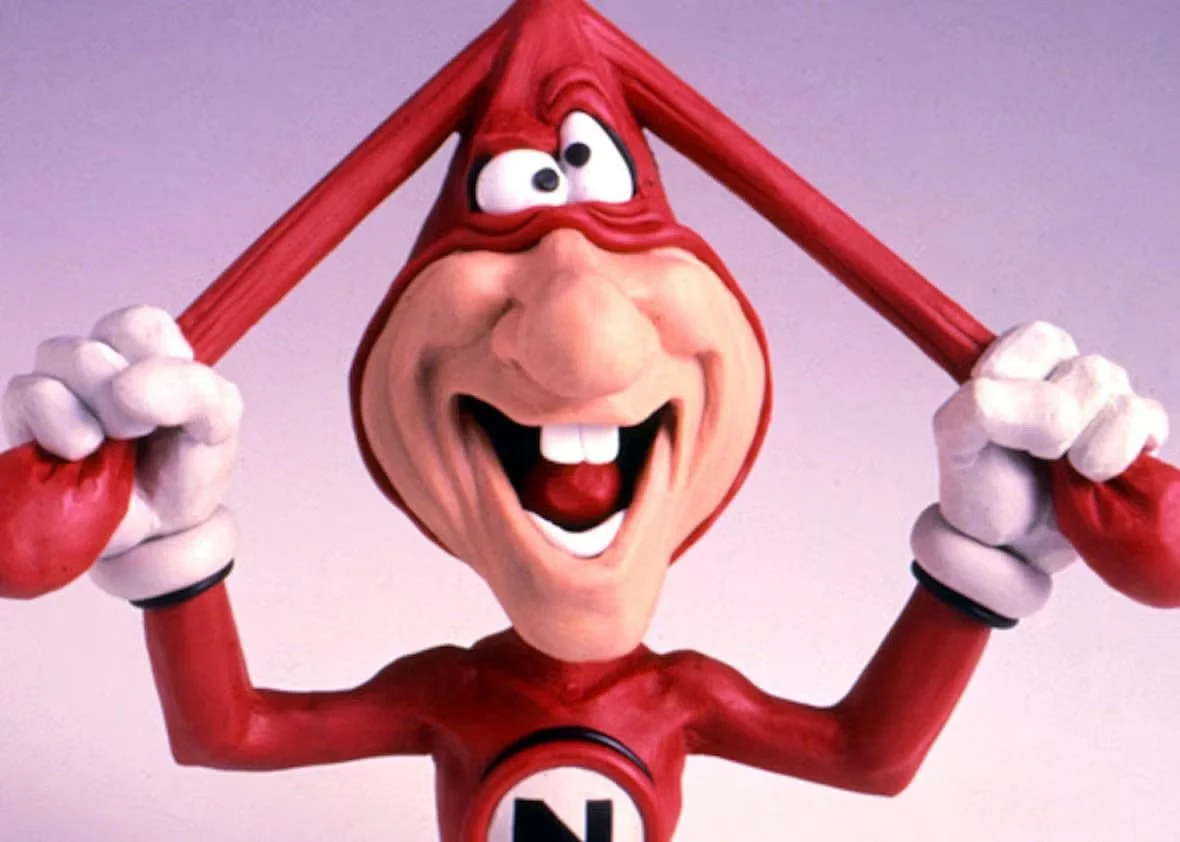
Buddy especially seems warm and soft, and while he should give kids a sense of security, instead he offers unpredictable violence. Not only does Buddy's appearance offer a distortion of our memories of mascots, but it also touches on the idea that many times the children's characters we grew up with can seem strange or unsettling in retrospect. For example, just look at the McDonald's Mac Moon or the Domino's Noid character shown below. Yikes!

The Major Metaphors in Buddy
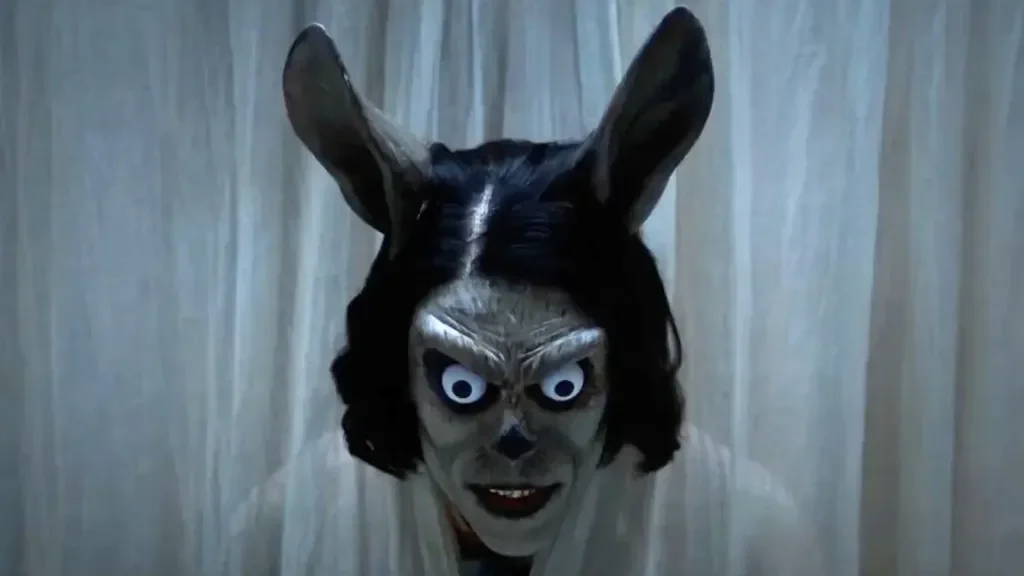
On the surface, Buddy is a fun horror movie that offers original dark comedy and plenty of gags. Beneath the surface, however, the film clearly grapples with dark subject matter. Buddy himself is an unreliable authority figure who forces compliance, first with verbal threats, then with physical violence. If none of that works, well…he kills them. Yes, this cuddly cute orange unicorn has no problem killing anyone who does not obey him.
He controls what information everyone sees, the language they use, and even their schedule. If it is play time, then you had damn well better play. The metaphor connection here is obvious. The clubhouse, where It's a Buddy takes place, is an allegory for a controlling, abusive home in which one figure, whether a parent or another relative, determines what everyone around them is allowed to feel.
The rules therefore get set up as follows:
Everyone must preserve the appearance of happiness.
Disobedience produces punishment.
Harm is hidden or renamed.
Missing people are explained through comforting lies.
The way the show resets day after day makes perfect sense in this regard. Amnesia is very common with children who have suffered some sort of abuse, as repressing the trauma is often the body's way of protecting itself. In Buddy, the missing memories are fragmented in a similar way that childhood trauma can be remembered.
In the case of Freddy, played by young actress Delaney Quinn, something feels wrong before she can fully explain it. Freddy’s discovery of physical evidence gives shape to a fear that was already present. Further, the world's reset closely models a form of the cycle of abuse.
Someone does something Buddy doesn't like or doesn't follow a predetermined rule.
Buddy becomes threatening or violent.
The evidence is removed or rewritten.
Buddy returns to affection and cheerful normality.
The cycle begins again.
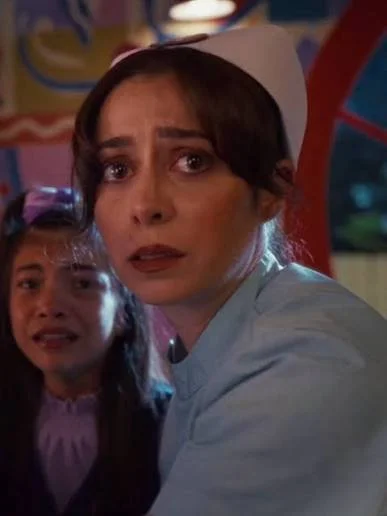
The film's commentary does not end with the children. The character of Grace follows a similar pattern, though it is more about those who are managing past abuse.
We are introduced to this character and her family as they go about their daily activities. But something is wrong. Grace firmly believes something is missing, and in that quest she is soon found transported into Buddy's world, straight through the TV.
Grace senses that part of her identity or history has been removed, and while she is right (I won't spoil it here), the knowledge comes with a price. Her storyline suggests that childhood experiences can continue shaping someone, whether good or bad, even when the memories are inaccessible.
Her connection to It’s Buddy! turns the film from a story about children escaping a monster into one about an adult attempting to recover a lost part of herself. It is a concept that becomes instantly recognizable for anyone who has gone through childhood trauma.
Why Buddy’s “Love” Is So Frightening
Yes, Buddy has plenty of death and violence, but that is not what makes his character horrifying. If anything, many of the more graphic scenes are moments where humor is used to break up the tension.
What is so disturbing about Buddy is how he repeatedly presents himself as affectionate and protective, but that is all surface level. His “love” is fully transactional. In order to receive his affections, you must play, dance, and sing at his request. Essentially, Buddy's love requires participation, agreement, and physical closeness.
Refusing him is treated as a deep betrayal, which always comes at a cost. At its core, Buddy appears to have its own lesson to teach the audience: to distrust the person who taught you what trust means.
The children must develop independent judgment despite having no experience outside Buddy’s controlled world. It is the only way to escape his “love” and survive.We have talked before about how the idea of love can be manipulated and corrected by a film, such as in Obsession (2026).
What Makes Buddy Worth Watching
Buddy continues Casper Kelly's fascination with familiar television worlds that ultimately become prisons. It is a prison that is colorful and fascinating, but still a prison all the same. What makes the film so unique isn't just the parody aspect, but that it is truly grappling with some serious subject matter. Though it is more subversive and less in your face than most horror.
Buddy is truly a monster, but because he presents himself as someone the children are supposed to love, it makes his dark reveal that much more sinister. Buddy is certainly a horror film worth watching and one not soon forgotten.
DIVE DEEPER INTO CINEMA WITH MORE FILM ARTICLES








Explore how Buddy (2026) turns children’s TV into a nightmare about forced happiness, abusive control, repressed trauma, and unreliable authority.